Hello, and welcome to the seventh week of The Global Fashion Files! The past, present, and future of women’s fashion in South Korea is the topic of this week’s post! Although South Korea does not have as long of a relationship with fashion as other East Asian countries, South Korea has cemented its place among the world’s top fashion capitals. The country’s subtle, elegant designs of the past clash in a surprisingly pleasant way with the bold streetwear of the present. As home to some of the world’s most advanced technology, South Korea’s fashion industry will undoubtedly be a leader in wearable technology. With an often underappreciated apparel history, an exciting contemporary fashion industry, and a promising future, South Korea will continue to attract global attention.
Past: Traditional Korean dress for women dates back to first century BCE. Known as hanbok, or “Korean clothing,” it consisted of the chima (skirt) and the jeogori (jacket). To wear these garments properly, women had to put on their undergarments, then the chima, followed by some sort of upper undergarment, and lastly the jeogori. Some women, depending on the weather, would wear a coat or vest over their outfit.
Both of the garments needed to be tied correctly. The chima is a large rectangular piece of fabric that has two sashes at the top, allowing the wearer to wrap and tie the skirt above the bosom or waist. The jeogori covers the top of the skirt, and the bow of the jacket points left. The jacket’s collar—often made of cotton or silk—is removable to allow for laundering.
Many of Korea’s original apparel styles were influenced by other cultures in Asia. In 200 BCE, Korea discovered silk production from their Chinese neighbors, and it was rapidly adopted as the preferred fiber for royal court. China’s Tang dynasty influenced Korean fashion further during the United Silla period (668-935 CE) as many women adopted Chinese styles. This influence continued into the Goryeo dynasty (until 1392) with dragon and crane motifs as well as new trims and embellishments. There were few changes to the basic silhouette of the garments, indicating Korea’s discerning adoption of foreign styles.
The lengthy Joseon dynasty (1392-1910 CE) took inspiration from China’s Ming dynasty. The period saw several changes to the hanbok, such as a shortened jeogori, contrasting borders and patches on the jeogori, and the fuller chima tied decoratively in the front. This style remains the predominant hanbok style in present day. While sumptuary laws prevented the average Korean woman from wearing certain styles of the upper class, all women wore similar styles by the nineteenth century.
The beauty of traditional Korean fashion lies in the elegant simplicity and thoughtful ornamentation. Embellishments inspired by the natural world as well as colors or designs associated with longevity and good fortune were frequently used in garments. The color of a hanbok could indicate a woman’s marital status, age, and even the presence of a husband or son in her life. However, history shows that Koreans in the past tended to favor white over bright colors, earning them the nickname “the white-clad people” for their apparel and peaceful tendencies.
In addition, quality fabrics played an important role in the creation of garments. Silk, cotton, hemp, wool, and union (constructed of various warp and weft fibers) were the most popular fabrics. Many individuals were involved in fabric production, and each person was assigned to a specific task, such as weaving cotton or creating gold yarn.
In the latter part of the twentieth century, some people continued to wear hanbok on a daily basis, visually expressing pride in their Korean identity. Eventually, the traditional hanbok was reserved for special occasions, such as weddings and birthdays. It is also possible to see individuals—Koreans and foreigners alike—wearing hanbok around historic sites in an attempt to enhance their cultural experiences.
Camille Fuller, who spent a semester studying abroad in Seoul, South Korea during her junior year in college, has fond memories of the traditional fashion in the country. She states, “The traditional Hanbok was often mixed into everyday attire. South Korean citizens and tourists were often spotted wearing these traditional garments at popular temples, palaces, and villages.” Camille recalls, “There were so many beautiful colors and patterns to choose from. It was amazing to experience putting the ensemble on and learning about the importance of what each piece of the outfit meant.”

Image: The back of a more modern Korean hanbok.
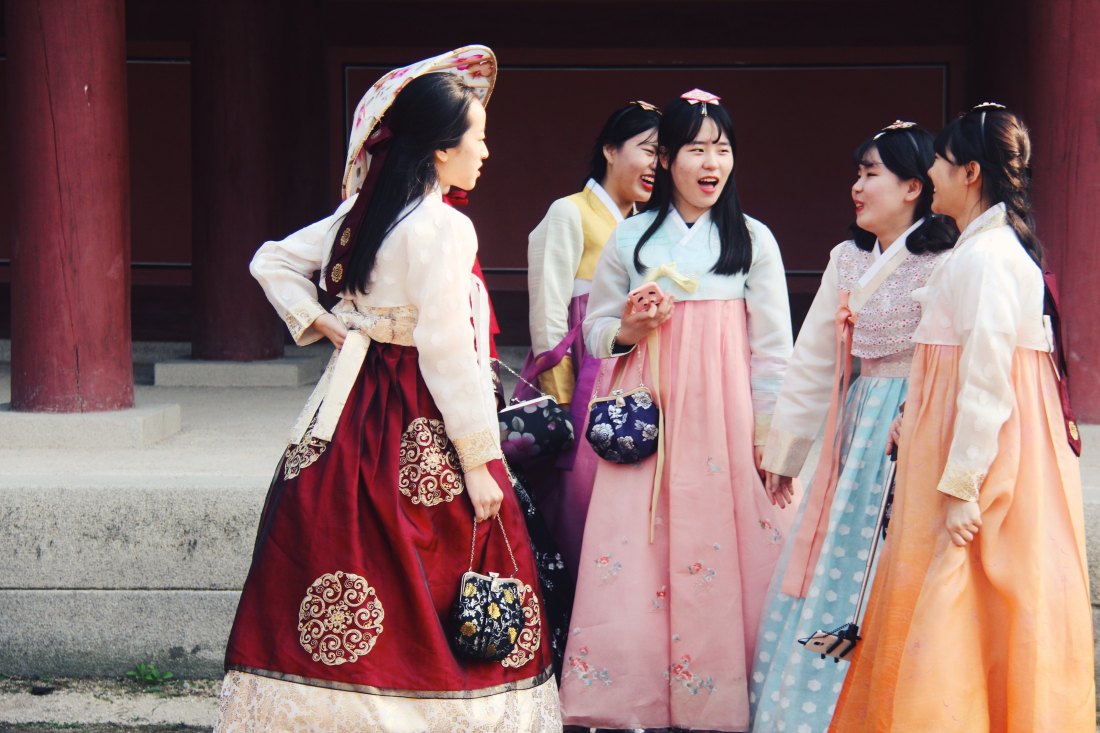
Image: A group of young Korean women wearing hanbok at a temple.
By the early 1900s, some Korean women adopted Western dress. In 1919, Christian missionaries visited and shared new styles with Korean women. Japanese occupation of Korea (1910-1944) introduced more contemporary styles to the country as well. By the Korean War (1950-1953), modern Western styles became more prevalent as women joined the workforce in larger numbers and transformed their social lives. Military styles in dark colors were quite common during the wartime period.
In the 1950s, South Korea’s modern fashion industry was born. New styles from the United States emerged, the first academic fashion institution opened in Seoul, several thriving fashion markets opened to the public, and fashion shows were introduced as well. By the 1960s, Korean women were experimenting with more daring styles, particularly miniskirts, and Korea’s first fashion magazine Uisang debuted in the country.
The 1970s and 1980s saw greater youth-led fashion movements. In the 1970s, youth favored bold styles like hot pants and punk-inspired clothing. The 1980s was a period for casualwear, such as t-shirts, jeans, and jumpers, popularizing athletic brands.
By the 1990s, Korean Pop—greatly influenced by hip-hop and rap music styles—inspired new fashion trends. At this point, much of the fashion in South Korea was practically identical in style to its Western counterparts. The 2000s saw the start of Korean styles popping up in the global market, inspiring international designers, and captivating the attention of consumers around the world.
Present: Fashion in South Korea today is an amalgamation of styles. From bold to subtle and daring to elegant, it is possible to see any of these elements represented in an individual’s outfit in Seoul. Therefore, it is fascinating to see the country’s varied street styles and distinct design aesthetics.
As a result of the younger demographic, streetwear is one of the most popular styles in South Korea. Younger shoppers tend to prefer trendy commercial brands that offer denim garments, logo t-shirts, and oversized hoodies. Yet, it is also possible to find people that pair streetwear-inspired garments with more tailored pieces, creating a unique look.
Because Seoul has a more youthful, street-focused fashion scene, it distinguishes itself from other major fashion cities like Paris and New York. The influential youth provide a different perspective about how to combine garments and take a greater interest in their personal appearance. They dedicate a lot of time to creating a complete look that corresponds to their personal style.
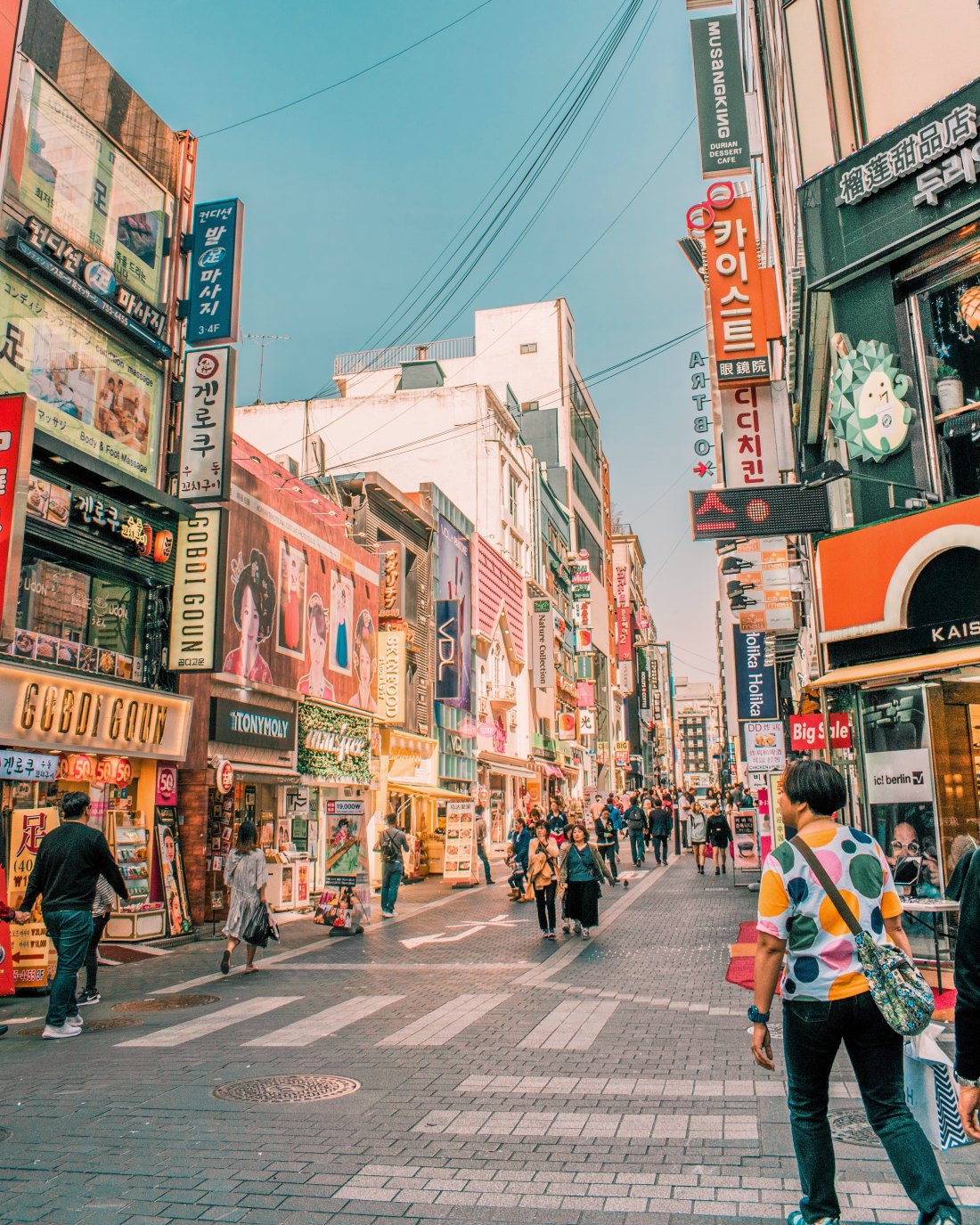
Image: A view of certain fashions on the streets of Seoul.
As one might expect, some of the fashion in South Korea, particularly sportswear, is greatly influenced by European and American styles. It is possible to find locations of countless mainstream international brands scattered throughout Seoul. Garments like ripped jeans, oversized pullovers, sneakers, hats, and casual blazers are wardrobe staples among many young Korean women.
Many individuals who have traveled to South Korea remark about the similarities to Western fashion, but they are also quick to point out the uniqueness of the country’s own fashion as well. Camille recalls, “There were definitely a lot of styles there that I saw in America.” However, she went on to state, “After buying a few of the pieces and wearing them in the US, people still ask me where I got them, as they haven’t seen anything like it.”
Another unique aspect of women’s fashion in South Korea is the propensity to layer garments. It is not uncommon to see a t-shirt layered under a button-down shirt with a blazer on top or a blouse layered underneath a sweatshirt. Although fashion in South Korea is constantly changing and each person has their preferred style, most women remain fairly conservative about exposing certain body parts. It is more common to see women baring their legs than their arms or shoulders. Therefore, Korean women greatly benefit from layering their clothes, which allows them to preserve a certain level of modesty while expressing their individual styles.
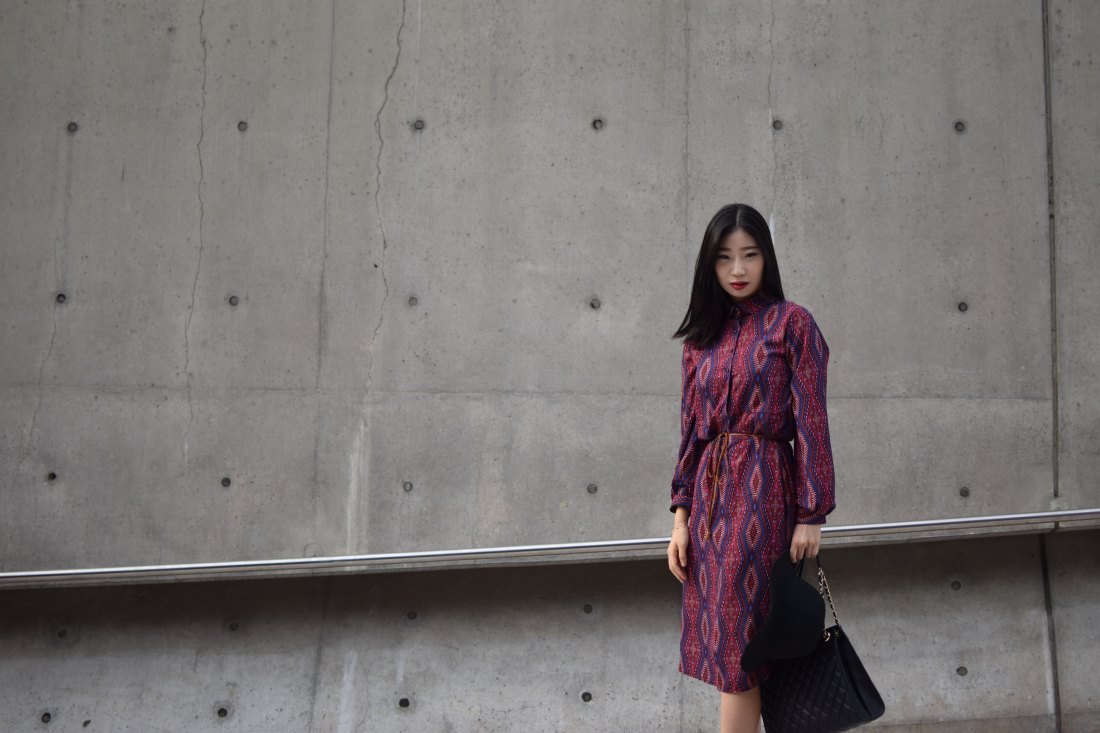
Image: A look worn by a woman in South Korea.
Despite the dominance of Western fashion brands, Seoul Fashion Week draws international attention to Korean designers every year. Held twice a year, the event features prominent designers and brands, placing particular emphasis on domestic ones. Celebrities, magazine editors, and wealthy consumers from all over the world regularly attend the event to view the fresh designs. In addition, the event promotes promising local designers, helping them gain international exposure. This is just one of the several ways that South Korea supports its many up-and-coming fashion designers in their endeavors.
While studying abroad, Camille Fuller was able to attend Seoul Fashion Week and provide a first-person perspective of the shows. She says, “Usually in America, attending a NYFW show is all about your connections. When in South Korea, my friends and I just reached out to two designers, who were hosting shows and they were gracious enough to give us tickets.” She fondly recalls the experience, stating, “The garments were beautiful and I never thought I’d attend a fashion show in another country. I think they were excited to share their creations with us! It was so sweet of them to allow us to attend.”
Every year, new Korean designers emerge, offering distinct design aesthetics. In 2018, Heta, EENK, and BESFXXK are listed as rising brands. Heta focuses on avant-garde, luxury womenswear that is gender neutral. EENK is a brand that prioritizes classic, occasionally vintage, pieces with a contemporary twist. Finally, BESFXXK creates garments that are multifunctional while merging historic and contemporary elements. These three brands alone illustrate the eclectic mix of fashion in South Korea.
Future: As one of the most connected countries in the world, it is unsurprising that much of South Korea’s future in fashion lies in technology. So far, the country is exploring the direct integration of technology into garments, using electronic devices to design collections, and enhancing consumers’ fashion experiences. Undoubtedly, the fusion of fashion and technology is a primary focus for South Korea’s fashion industry as it moves into the future.
One major company in South Korea is at the forefront of exploring the relationship between technology and fashion: Samsung. Unbeknown to many people, there is a sector in Samsung entirely dedicated to fashion called the Fashion Group. Founded in 1954, Samsung C&T Fashion Group was a textile company that owned high-quality factories. In the 1970s and 1980s, they expanded their business with licensing. Other international brands, such as Tory Burch and rag & bone, teamed up with Samsung in order to break into the increasingly profitable luxury market in South Korea. Samsung serves as a distributor of the brands, working with them to run their businesses and manage their stores.
In addition to distributing international brands, Samsung’s Fashion Group has several independent fashion brands of their own. Galaxy, Beanpole, KUHO, LEBEIGE, and 8seconds are just some of the brands under Samsung’s Fashion Group umbrella.
In addition, Samsung supports South Korea’s fashion industry in other ways. Samsung Fashion Institution is a group of industry experts, Samsung Design Net is Korea’s biggest fashion database, and Samsung Fashion Design Fund helps ambitious young designers in achieving their dreams. Since they have already established a strong presence in South Korea, Samsung’s Fashion Group intends to branch out into the global market, advocating Korean fashion throughout the world.
To assist in gaining greater recognition, Samsung is a strategic partner of the Council of Fashion Designers of America (CFDA). For the first time in 2017, Samsung teamed up with the CFDA to offer a unique experience to attendees at the CFDA Fashion Awards After Party. Individuals utilized virtual reality technology and a 360-degree photo booth at the party. Plus, they had the opportunity to purchase wearable technology items. Events like this further strengthen Samsung’s relationship with the global fashion industry, and it is likely the company will continue to pursue a closer association.
Samsung also provides technology to designers around the world to help them succeed in their careers. Aurélie Fontan, a London-based designer, produced the world’s first capsule couture collection from the Samsung Galaxy Note9. She sketched, wirelessly communicated with production devices, printed three-dimensional fastenings, and painted patterns on fabric. By synchronizing all of her apps with the suppliers, she was able to communicate with them and modify her designs regardless of her location, accelerating the prototyping and development processes. Composed of recyclable leather and biodegradable 3D plastic fastenings, it took Fontan six weeks to produce the entire collection from concept to final garment.
Fontan’s one-of-a-kind collection demonstrates a new design method that could become standard in the future. Most of the fashion industry’s success lies in the ability to respond quickly to consumers’ needs and build strong relationships with global partners. Being able to collect inspiration, control production devices, and communicate instantly and effectively with design and manufacturing partners anywhere in the world, it is clear that the Samsung Galaxy Note9 presents new possibilities for innovative designers.
The Last Stop: There is no denying South Korea’s important role in the global fashion industry. Although there is less information available about the history of fashion in South Korea than other East Asian countries, it is certainly a worthy topic. The hanbok—an enduring symbol of Korean women’s identity—is an elegant and intriguing historic costume. Although the hanbok is still worn today, much of the fashion seen on the streets of Seoul is modern and youthful with an emphasis on streetwear. The eclectic mix of fashion attracts attention from individuals all over the world, repeatedly drawing them to Seoul Fashion Week. As the country moves into the future with a focus on emerging designers and fashion-oriented technology, the global fashion industry will continue to recognize South Korea as a fashion leader.
Thank you to all of my readers! If you found this information helpful and inspiring, or you would like to see a specific topic featured in one of my weekly blog posts, leave a comment. Be sure to check out my previous posts on the past, present, and future of fashion in France, Egypt, Nigeria, Japan, England, and Spain. Next week, our exploration of the past, present, and future of women’s fashion will take us to a country with which I am thoroughly familiar: the United States!
My Resources, Your Resources:
“About SFW.” Seoul Fashion Week, http://www.seoulfashionweek.org/aboutSFW?langSet=english. Accessed 25 Oct. 2018.
Amarca, Nico. “Why Seoul, South Korea Is the Hottest Fashion City in Asia.” Hypebeast, 2 Nov. 2017, https://hypebeast.com/2017/11/korean-fashion-2017. Accessed 25 Oct. 2018.
Chang, Katie. “Three South Korean Fashion Designers You Need to Know.” Forbes, 31 July 2018, https://www.forbes.com/sites/katiechang/2018/07/31/three-south-korean-fashion-designers-you-need-to-know/#2bc34fe3e8d1. Accessed 25 Oct. 2018.
“Clothing and Fashion.” Korea, http://www.korea.net/AboutKorea/Korean-Life/Clothing. Accessed 25 Oct. 2018.
“Fashion Group.” Samsung CNT, http://www.samsungcnt.com/eng/business/fashion.do. Accessed 25 Oct. 2018.
Han, Hyonjeong Kim and Yun Gyun S. Hong. Couture Korea. San Francisco: Asian Art Museum, 2017.
“Inspiring and Empowering Creators in Fashion.” Samsung, 13 June 2017, https://news.samsung.com/us/CFDA-awards-837nyc-inspiring-and-empowering-creators-in-fashion/. Accessed 25 Oct. 2018.
Karimzadeh, Marc. “Samsung’s Fashion Evolution.” CFDA, 19 Sept. 2016, https://cfda.com/news/samsungs-fashion-evolution. Accessed 25 Oct. 2018.
Kim, Dianne P. “12 Items You Should Add In Your Closet To Get That Korean Fashion Look.” Soompi, 23 Mar. 2018, https://www.soompi.com/article/1139791wpp/12-items-add-closet-get-korean-fashion-look. Accessed 25 Oct. 2018.
“Mobile Couture: French Designer Creates World’s First Fashion Collection Produced by a Smartphone.” Samsung, 18 Oct. 2018, https://news.samsung.com/uk/mobile-couture-french-designer-creates- worlds-first-fashion-collection-produced-by-a-smartphone?utm_source=rss&utm_medium=direct. Accessed 25 Oct. 2018.
Samuels, Gabriella. “Evolution of South Korean Fashion and Makeup Culture.” Asia House Arts, 2 July 2018, https://asiahousearts.org/evolution-south-korean-fashion-makeup-culture/. Accessed 25 Oct. 2018.
Welters, Linda, and Abby Lillethun. Fashion History: A Global View. Bloomsbury Academic, 2018.

 The Global Fashion Files