Hello, and welcome to the sixth week of The Global Fashion Files! In this week’s post, we will explore the past, present, and future of women’s fashion in Spain! Although Spain is not often the first country to come to mind when fashion is mentioned, the country has made many notable contributions to fashion in the past, including popularizing dark colors. Spain continues to establish its place among the elite fashion countries. In the present, the world is easily able to identify Spanish brands like Zara and enjoy the colorful, eccentric garments created by local designers. As Spain works toward gaining further global recognition, new technology, up-and-coming brands, and a strong fashion market will assist the country in achieving its goal.
Past: In the sixteenth century, Spain was at the forefront of fashion, even influencing Western fashion. Many of the Spanish styles were bulky and unwieldy. It took some women hours to dress in the latest garments. Capes and corsets were common items in women’s wardrobes, and they were often made of thick fabrics with colorful embroidery as adornment.
At this time, floor-length dresses with stiffer skirts and without trains were the most popular style. In order to achieve this silhouette, women wore Spanish farthingales, or a structural support device made of either whalebone, cane, or steel and formed into a cone shape. These hoops—also known as verdugale or verdugado— were sewn into the petticoat or underskirt, but they could also be sewn directly into the dress. When worn with a gown, the supporting hoops created an hourglass shape. Spanish farthingales were prevalent in Spain and were eventually adopted in other parts of Europe as well.
Another item of Spanish origin is the ropa. The ropa was an unbelted, A-line outer gown with no sleeves or sleeves of various types, such as short, puffed ones or long ones. While some styles of this outer gown were closed in the front, most ropas were open, showcasing the dress underneath it. It is possible this style of dress originated from the Middle Eastern caftan, which also featured a looser fit.
Under Philip II’s reign, it became popular to dress like a Spaniard. Black became the predominant color choice for individuals who hoped to display sophistication and wealth. It was a challenging and costly color to preserve, but Spaniards soon found a plant that helped them attain a deep and fairly permanent black color. With the intention of selling the long-lasting black dye and earning revenue for the Spanish Crown, Philip II embarked on making the color black fashionable. Ultimately, it became essential to possess at least a few articles of black clothing to adhere to the new trend.
In addition to the color black—which was most often worn for special occasions— luxurious, thick fabrics and intricate embroidery were used in the creation of many Spanish styles. Gold and silver threads were greatly utilized in the embellishment of clothing. Other bold colors were integrated into women’s wardrobes as well, whether it was red fabric for a dress or opulent gold jewelry with brightly-colored precious stones.
Despite its obvious influence on European fashions in the sixteenth century, Spanish style remained rather stagnant. As a result, many of the styles of the seventeenth century were dictated by France and England. Spain’s citizens gained knowledge of the latest trends through traveling noblemen and noblewomen, fashion manufacturers, French dressmakers who established businesses in the country, and the press.
By the nineteenth century, upper-class women and prominent Spanish dressmakers traveled to Paris regularly to stay up-to-date on the newest fashions. The twentieth century saw the rising popularity of local dressmakers, including Carolina Montagne and Pedro Rodriguez, in Barcelona and Madrid. However, these individuals gained little to no recognition for their designs outside of the country.
Undoubtedly, the Spanish designer who was best known domestically and internationally in the twentieth century is Cristobal Balenciaga. In 1916, he established a shop in San Sebastian, but he later moved to Paris in 1937. At the beginning of World War II, he returned to Spain to avoid the war. Following the conclusion of World War II, he returned to Paris to reopen his shop and became one of the greatest designers of Paris couture.
Balenciaga utilized muted browns and blacks reminiscent of older Spanish styles and influences of abstract and cubist art can be found in his designs. He sculpted his garments to the female body from a semi-fitted suit jacket to a cocoon coat to a flamenco evening gown that was short in the front and longer in the back. In order to accomplish the sculptural effects he needed for his designs, he and Swiss fabric house Abraham produced a silk named gazar, which is very lightweight but capable of retaining a shape and hanging away from the body.
Cristobal Balenciaga closed his Paris fashion house in 1968 and returned to Spain at the age of seventy-five. He is revered for his attention to detail, particularly the proportion and cut of his garments. Perhaps the greatest defining characteristic is the architectural element of many of Balenciaga’s designs. These distinguishing features helped him attain a place among the greatest couturiers of the twentieth century.
It was only in the mid-1980s that Spanish fashion significantly expanded into the global market. The government assisted in the revitalization of Spain’s fashion industry, particularly by establishing the Center for the Promotion of Design and Fashion (CPDM), creating awards to honor the most talented individuals, and displaying Spanish fashion in numerous museum exhibitions. In addition, the rapid expansion of Spain’s ready-to-wear sector with the assistance of major retailers like Zara helped global customers begin to more closely associate the country with fashion.
Since the 1980s, Spain has become home to numerous international fashion brands as well as smaller Spanish brands. Therefore, it is fairly common for women to mix-and-match garments from larger international brands along with pieces from domestic ones. As women’s wealth and professional opportunities grew, they showed a preference for classic clothing from designer brands. However, many women still took pride in wearing Spanish brands that offered designs similar to other international brands.
Despite the more modern styles now found in Spain, some traditional styles endured through the years. The mantilla is a veil headpiece constructed of light lace or a silk scarf worn over the head and shoulders and held in place with a peineta, or a sizable ornamental comb. A gilet, or a chaleco in modern Spanish, is a tailored, sleeveless jacket that is tastefully embroidered. Furthermore, flamenco performers still wear traditional Spanish dresses in red, white, or black. Although these garments may be worn on a daily basis, they are often reserved for special occasions, and the styles may vary from region to region.
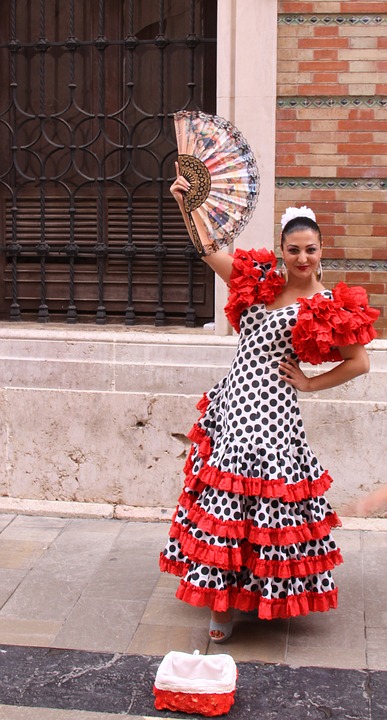
Image: A traditional Spanish dress worn by a flamenco dancer.
Present: The fashion industry in Spain is flourishing in present day. Many factors contribute to the country’s current success. The profitable textile industry, a variety of Spanish fashion companies, Madrid Fashion Week, and the plethora of chic styles help Spain maintain its position in the global fashion industry.
In the past, quite a bit of emphasis has been placed on the fabrics used to create garments. Therefore, it is unsurprising that Spain’s textile industry plays a vital role in the global fashion industry. In fact, leather and textile goods are among Spain’s chief exports, indicating an international demand.
In addition, Spanish brands and designers are not only becoming increasingly profitable, but they are also becoming household names worldwide. Inditex Group—best known as the parent company of Zara—is the most well-known Spanish fashion company. With almost two thousand stores globally, the company can produce up to thirteen sizes of the same garment, but they never repeat a design—despite introducing and selling numerous new designs twice a week. Beyond Zara, other stores, including Loewe, Camper, Desigual, Mango, and Cortefiel, have found success in Spain. Designers, such as Paco Rabanne and Ágatha Ruíz de la Prada, have become fashion sensations in Spain and abroad, developing new trends. One commonality among brands and designers in Spain is their shared understanding of the need to respond quickly to changes in the fashion industry and repeatedly attract their target consumers to increase sales.
Madrid Fashion Week also plays a critical part in stimulating Spain’s fashion industry. Annually, the best Spanish designers gather to present their collections. The money collected from ticket sales for entrance to the shows supports organizations that encourage further internationalization of Spanish fashion companies.
Styles in Spain are very similar to styles in Western countries. While personal style can vary—some women may wear bohemian, punk, or preppy looks—Spanish women in cities like Madrid and Barcelona will wear chic designer clothing. The majority of fashion choices are a combination of comfort and style, which complements the laidback attitude of most Spanish individuals.
There are a variety of color options in Spain, but women tend to wear colors that are specific to certain seasons. Dark colors and earth tones are common in fall and winter. Although subdued colors may also be worn into spring, bright colors begin to creep into women’s wardrobes. By summer, women are wearing bright colors regularly.
The seasons play an important role in dictating women’s wardrobes. In fall, winter, and spring, women often wear layers, such as jeans, a blouse, a sweater, and a jacket, in order to adapt to the fluctuating temperatures. By summer, Spanish women wear garments that are lightweight and flowing, such as dresses, mid-length shorts, and tank tops. Regardless of season, most women in Spain’s cities will keep their wardrobe fairly conservative to avoid showing too much skin.

Image: An example of fashion on the streets of Barcelona.
Future: Spain has great potential to expand its fashion industry both inside of and outside of the country’s boundaries. Individuals in other parts of the world already recognize the country for its more recent contributions to fashion, particularly Zara. With strong emerging fashion cities like Barcelona, a growing demand for the latest fashions, and the development of several cutting-edge technology companies, Spain is poised to regain its place as a fashion leader.
The Global Language Monitor is an organization that tracks how often cities are mentioned on blogs, journals, newspapers, and websites to determine the ten leading fashion cities each year. Basically, it uses this data to ascertain the trending topics. For many years, Barcelona has earned its spot among a variety of other prominent cities, including Tokyo, Shanghai, Los Angeles, and Rome. Its popularity is attributed to the country’s influential youth population and the increase in vibrant, quirky Spanish fashion. It is expected that Barcelona will maintain its position on this list as the city continues to generate interest from around the world.
Meanwhile, in Spain, consumers are showcasing a growing interest in fashion. It is expected that apparel spending will increase 10.6% by 2019, making it the European country with the largest increase in fashion consumption. This is due in part to less expensive fashion retailers, such as Shana, H&M, Blanco, and all of the Inditex Group brands. These apparel brands succeed because they are able to quickly respond to consumers’ needs and offer fashionable clothing options at affordable prices. In addition, the prevalence of online shopping contributes to this increase in sales in the e-commerce sector of Spain’s fashion industry.
In general, the world is fascinated with the recent emphasis on the blend of fashion and technology, and Spain is no exception. Several tech startups—all headquartered in Barcelona—are assisting Spain’s fashion industry with breaking into the future. Moves to Slow Fashion is an online retail platform that offers customers an alternative to fast fashion, presenting them with chic apparel from ethical and sustainable designers. Wide Eye Technologies, an artificial intelligence-focused company, created software that allows individuals to take a photo of their favorite celebrity outfit in a magazine and locate a less expensive alternative. The software utilizes image recognition to find a similar outfit among its partner stores’ collections, and it is even capable of recommending complementary items. Other tech companies and apps like YUME_HUB, Brand Your Shoes, Privalia, and Wallapop are ushering in a new era for the global fashion industry.
The Last Stop: It is possible to say that Spain has one of the most tumultuous relationships with fashion. Once at the height of fashion in the sixteenth century, the country gained little global recognition until the 1980s. However, with the youth’s influence and a greater presence of Spanish brands domestically and abroad, Spain’s fashion industry has managed to reclaim some its former glory. New efforts to expand domestically and internationally and keep up with the latest trends—technology and otherwise—will bolster Spain’s plans to become a global fashion powerhouse in the future.
Thank you to all of my readers! If you found this information helpful and inspiring, or you would like to see a specific topic featured in one of my weekly blog posts, leave a comment. Be sure to check out my previous posts on the past, present, and future of fashion in France, Egypt, Nigeria, Japan, and England. We will explore the past, present, and future of women’s fashion in South Korea next week!
My Resources, Your Resources:
Alford, Holly Price, and Anne Stegemeyer. Who’s Who in Fashion. 5th ed., USA, Fairchild Books, 2009.
Bergin, Hannah. “The Top 10 Up-and-Coming Fashion Capitals of the World.” The Culture Trip, 29 Jan. 2018, https://theculturetrip.com/europe/spain/articles/top-10-up-and-coming-fashion-capitals/. Accessed 21 Oct. 2018.
James, Mike. “Spanish Influences on the Fashion Industry.” Spain Buddy, 20 May 2014, https://www.spainbuddy.com/spanish-influences-on-the-fashion-industry/. Accessed 20 Oct. 2018.
Justine. “How to Dress in Barcelona According to Season.” Latitude Forty One, 30 Mar. 2018, https://latitudefortyone.com/how-to-dress-in-barcelona-according-to-season/. Accessed 20 Oct. 2018.
Magyar, Vivien. “6 Barcelona Startups That Are Changing Fashion Through Technology.” Barcelona Startup News, 21 Apr. 2017, https://barcelonastartupnews.com/top/6-barcelona-startups-that-are- changing-fashion-through-technology/. Accessed 21 Oct. 2018.
Mendez, Lola, and Sebrin Elms. “What to Pack for Spain Vacations: Year Round Packing List.” Travel Fashion Girl, https://www.travelfashiongirl.com/what-to-pack-for-spain-vacations-a-seasonal-guide/. Accessed 20 Oct. 2018.
Miller, Lesley Ellis. “Spanish Dress.” Love to Know, https://fashion-history.lovetoknow.com/clothing-around-world/spanish-dress. Accessed 20 Oct. 2018.
“Spain.” Every Culture, https://www.everyculture.com/Sa-Th/Spain.html. Accessed 20 Oct. 2018.
“10 Things You Didn’t Know About Fashion in…Spain.” Stylight, 8 Dec. 2015, https://blog.stylight.com/10-things-you-didnt-know-fashion-in-spain-2/. Accessed 20 Oct. 2018.
Tortora, Phyllis G., and Keith Eubank. Survey of Historic Costume.5th ed., USA, Fairchild Books, 2010.
“Traditional Spanish Dresses.” Don Quijote, https://www.donquijote.org/spanish-culture/traditions/spanish-clothing/. Accessed 20 Oct. 2018.

 The Global Fashion Files