
Hello, and welcome to the fourth week of The Global Fashion Files! This week, we will take a look at the past, present, and future of women’s fashion in Japan. The history of fashion in Japan is a breathtaking combination of tradition and modernity. From traditional kimonos to deconstructed avant-garde garments to colorful street styles, Japan’s fashion is a feast for only the most stylish eyes!
Past: When thinking of fashion in Japan, the kimono is often the first article of clothing that comes to mind. Translated as “the thing worn,” the kimono is characterized by its “T” silhouette, straight seams, and intricate detailing. The origins of the garment can be traced back as far as the fifth century, but it is often cited as being in existence since the eighth century.
Throughout the years, the kimono was worn in a variety of ways, including with or without aprons and trousers. It was tied with an obi, or a sash to hold the garment in place, that gradually became wider and was capable of being tied in elaborate knots. In the late sixteenth century, the kimono started to take on the appearance we associate with it today— a long robe with wide sleeves. The length of the sleeves indicated if a woman was married or not.
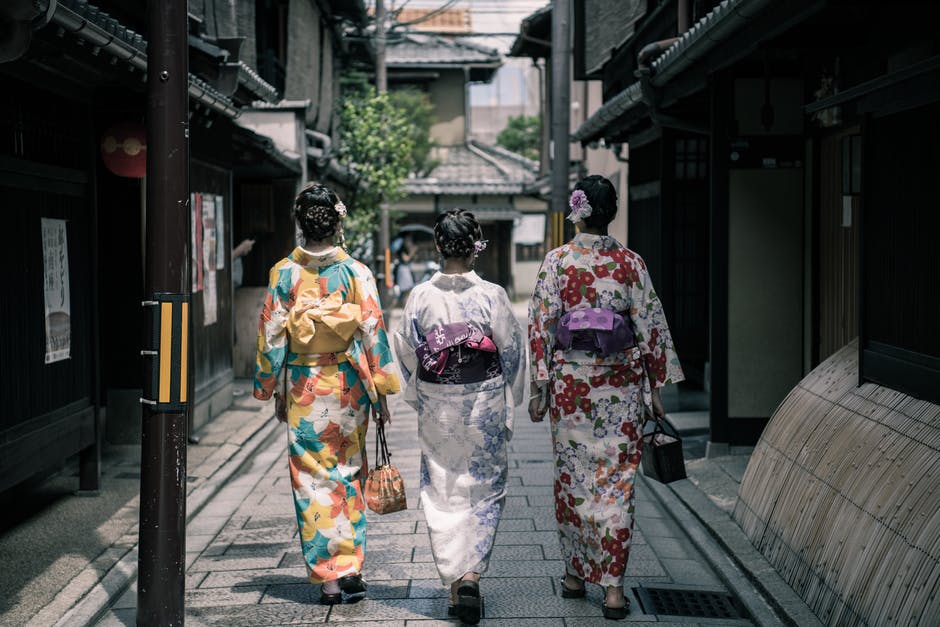 Image: Three women wearing kimonos tied intricately with obis.
In summer, a lighter, less formal kimono known as a yukata was worn by women and men. Yukatas were constructed of cotton and did not have a lining. Typically, younger individuals wore yukatas in bright colors and bold patterns and older individuals wore them in subdued colors with more understated prints.
Prior to the kimono, Japanese robes were referred to as kosode, “small sleeves,” or osode, “long sleeves.” Despite their translations, the names of the garments did not refer to the sleeves. Instead, they indicated the size of the garment’s armholes. At one point, the kosode was the main garment worn by wealthy and influential Japanese citizens, but, ultimately, it became the primary clothing item for everyone, regardless of sex or class, in Japan.
Since the dawn of the Edo period (1603 -1868), the style of the kimono has remained fairly unchanged. The garment hangs loosely on the body, masking the wearer’s figure beneath it. Because the silhouette is relatively standard, the distinguishing elements of the garment come from the fabrics and embellishments.
Around 300 B.C., the production of silk made its way from China to Japan, introducing a new textile to the country. Silk and cotton are the primary fabrics for kimonos. Multi-colored woodblock prints, embroidered floral prints, and woven floral prints are quite common on kimonos. Some of the most widely recognized patterns are cherry blossoms and butterflies. As a result of the country’s interest in fabrics, Japan became the first non-Western country to utilize textile industrial methods on a bigger scale, making them a major textile exporter by the end of the nineteenth century.
Interestingly, there are many little known facts surrounding kimonos. During the Edo period, red kimonos were forbidden, but some individuals lined their garments with red fabric to bypass the rule. In addition, every time a kimono was laundered, it was disassembled into seven pieces and air dried before being stitched back together.
In the Meiji period (1868-1912), Western styles began to influence Japanese fashion. Kimonos still dominated as the primary style, but women began to wear Western-type boots. The Taisho era (1912-1926) saw some women beginning to experiment with more Western fashions and bolder kimonos. By the Showa period (1926-1989), women began to wear Western-style clothing more regularly, even in the home.
From the 1940s to 1950s, Japan adopted what they called the “American style,” and many women’s outfits reflected American or French influences. With the introduction of foreign films in the 1950s, Japanese women began to wear styles influenced by their favorite American movie stars, such as Audrey Hepburn. The 1960s saw young people establishing themselves as the country’s fashion influencers. Fashion in Japan became more casual and the demand for ready-to-wear trends like the miniskirt became prevalent. In the 1970s, women wore the female equivalent of men’s American Ivy League fashion with knee-length skirts, polo shirts, and sweatshirts.
The deconstruction movement also emerged in the 1970s and gained popularity in the 1980s. Japanese designers, including Rei Kawakubo, Issey Miyake, and Yohji Yamamoto, popularized the more avant-garde style that challenged conventional female silhouettes. Along with its androgynous elements, deconstructed fashion highlighted imperfections instead of hiding them.
The 1990s saw women in Japan becoming more fashion conscious and Japanese designers gaining worldwide attention. As a result, several designers opened up high-end fashion houses in major cities throughout the world. Many American and European fashion editors began to regard Tokyo as a fashion capital, making special trips to Japan to view local designers’ collections and share their observations with the international audience. Local fashion trends abounded but Western brands, such as Chanel, Yves Saint Laurent, and Gucci, thrived as well.
There are several fashion subcultures in Japan that emerged in the 1980s and 1990s. Harajuku style stands for an eclectic mix of Japanese substyles that are far from mainstream. Kawaii, or “cute,” “lovable,” and “adorable,” became popular among women in their twenties and thirties who wanted a cuter, somewhat more innocent style. Cosplay, or the act of roleplaying as a favorite character from manga and anime, is another style adopted by some youth. These are just a few examples of countless Harajuku styles that are still worn today.
In the twenty-first century, “fast fashion” dominated in Japan and well-known Japanese brands expanded abroad. International luxury brands, such as Prada, Versace, Louis Vuitton, and Burberry, expanded in large numbers into the Japanese market as well. At one point, Japan accounted for forty to fifty percent of the luxury goods market as it was not uncommon for teenagers and adults alike to purchase high-end fashion products.
Present: Japan’s current fashion industry is just as intriguing as its predecessor. Styles from every period of Japan’s history are seen on the nation’s streets. Kimonos are still occasionally worn—although they are no longer representative of the current fashions—but unique street styles and foreign brand name garments prevail.
Today, it is still possible to see young women dressing up in Harajuku styles, but this trend is on the decline. In fact, most individuals prefer more subdued styles. Uniqlo, Japan’s expanding apparel company that focuses on basic garments, is one possible reason. The company produces garments in minimal silhouettes and muted colors, allowing consumers to purchase fashionable clothing at reasonable prices.
In addition to foreign luxury fashion brands like Gucci and Hermes, fast fashion brands from abroad are popular as well. H&M and Forever 21 offer inexpensive clothing options for women in Japan. The prevalence of these mainstream brands means that most of the fashion on the streets of Japan appears more ordinary than bold.
 Image: Typical styles on the streets of Tokyo.
However, creative fashion and a dynamic blend of styles are still more common in Japan than in the United States. It is possible to find women on the streets of Tokyo who dress in an artistic way, pushing the boundaries of conventional fashion. With the emergence of new design talent, including Limi Feu and Tae Ashida, and a growing international awareness of Japanese brands, Japan’s fashion industry is primed to experience an artistic fashion renaissance.
Future: Looking to the future, Japan is attempting to revive its fashion industry and expand into international markets. Young designers are at the forefront of the revival. Masayuki Ino, the designer of gender-neutral streetwear brand Doublet, won the 2018 LVMH Prize for emerging talent, becoming the first Asian designer to win the primary award. His brand mostly designs streetwear basics like hoodies, t-shirts, and sneakers with graphic prints and popular culture references. Other Japanese brands and designers like sk8thing, Chisato Tsumori, Yu Amatsu, and Hiroko Takahashi are gaining popularity in Japan. The fusion of traditional and modern and East and West is helping Japanese designers achieve recognition internationally as well.
A school in Tokyo is also helping to move the Japanese fashion industry forward, encouraging future designers to express their individuality. Founded in 2008 by designer Yoshikazu Yamagata, Coconogacco differs from other Japanese design schools in that it prioritizes individuality over technique. It encourages students to experiment with and showcase their creativity rather than perfect the construction of a garment. As of May 2018, over one hundred students are enrolled in Coconogacco’s five courses. Several successful students, including Akiko Aoki who was a finalist for the 2018 LVMH Prize, have graduated from the program. In the future, Yamagata hopes to collaborate with other fashion schools around the world, introducing students to different philosophies and opportunities.
As in most other countries, Japan is working on technology to benefit the fashion industry. Start Today, a Japanese firm that operates the Zozotown platform and its own private label, Zozo, created the Zozosuit to allow consumers to buy custom-made clothing from their phones. The suit is composed of leggings and a top that are skintight and covered in about three hundred white sensors that record numerous body measurements with the assistance of a smartphone app.
To use the Zozosuit, consumers must put on the garment, launch the app on their phone, and perform a slow twirl in front of the phone, allowing it to take twelve photographs that measure twenty-four parts of the body. The images from the 3-D scan of the body are used to create custom clothing, which consumers can purchase directly from the app. At the very least, the measurements can also be used to recommend the proper size for a particular garment from the over six thousand brands on the Zozotown platform.
The Zozosuit retails for around $350 and is already gaining international attention. The company expects to sell over ten million suits by March 2019 since it is now available in seventy-two countries. This product has the potential to revolutionize the e-commerce sector of the fashion industry, particularly by reducing the number of garments returned to brands because of fit issues. Yusaku Maezawa, founder of Start Today, believes that fashion should be made to fit people as opposed to people trying to fit into predetermined sizes.
The Last Stop: Japan has a lengthy and captivating relationship with fashion. From traditional kimonos to the various substyles of Harajuku to the modern Japanese and Western fashion brands, the country has an undeniably eclectic mix of garment options. With emerging design talent, new fashion schools, and an interest in digital technology, Japan’s fashion industry continues to expand and seek greater recognition internationally, making it a worthy addition to the global fashion industry.
Thank you to all of my readers! If you found this information helpful and inspiring, or you would like to see a specific topic featured in one of my weekly blog posts, leave a comment! Be sure to check out my previous posts on the past, present, and future of fashion in France, Egypt, and Nigeria! Also, stay tuned for next week’s post on the past, present, and future of women’s fashion in England!
My Resources, Your Resources:
Ahuja, Shilpa. “Japan: Its Influence and Contributions to Global Fashion.” University of Fashion, 22 Jan. 2017, https://www.universityoffashion.com/blog/japan-influence-contributions-global-fashion/. Accessed 5 Oct. 2018.
Bain, Marc. “Japan’s Wild, Creative Harajuku Street Style is Dead. Long Live Uniqlo.” Quartz, 22 Feb. 2017, https://qz.com/909573/japans-wild-creative-harajuku-street-style-is-dead-long-live-uniqlo/. Accessed 5 Oct. 2018.
Chitrakorn, Kati. “The Japanese Fashion School That Could Birth the Next Rei Kawakubo.” Business of Fashion, 15 May 2018, https://www.businessoffashion.com/articles/education/coconogacco-tokyo-japan-fashion-school-next-rei-kawakubo. Accessed 6 Oct. 2018.
Dayman, Lucy. “10 Japanese Fashion Designers You Should Know.” The Culture Trip, 5 June 2018, https://theculturetrip.com/asia/japan/articles/top-10-japanese-fashion-designers-you-should-know/. Accessed 6 Oct. 2018.
Demetriou, Danielle. “The Revolutionary High-Tech Suit You Wouldn’t Be Seen Dead Wearing.” The Sydney Morning Herald, 1 Sept. 2018, https://www.smh.com.au/lifestyle/fashion/the-revolutionary-high-tech-suit-you-wouldn-t-be-seen-dead-wearing-20180828-p5007m.html. Accessed 6 Oct. 2018.
Frank, Priscilla. “A Brief and Stunning Visual History of the Kimono.” Huffington Post, 4 April 2016, https://www.huffingtonpost.com/entry/a-brief-and-stunning-visual-history-of-the-kimono_us_5702abbce4b0daf53af03e8b. Accessed 5 Oct. 2018.
Garner, Ashley. “Japanese Fashion: A History.” L’Etage Magazine, 15 Jan. 2013, http://www.letagemagazine.com/japanese-fashion-a-history/. Accessed 5 Oct. 2018.
Hays, Jeffrey. “Fashion in Japan: History, Japanese Designers, Poor Marketing, and Brand-Name Mania. ” Facts and Details, Jan. 2013 http://factsanddetails.com/japan/cat20/sub136/item743.html. Accessed 5 Oct. 2018.
“Japan’s Start Today Gives Clothes Retailers a Glimpse of the Future.” The Economist, 18 Aug. 2018, https://www.economist.com/business/2018/08/18/japans-start-today-gives-clothes-retailers-a-glimpse-of-the-future. Accessed 6 Oct. 2018.
Kawamura, Yuniya. “Japanese Fashion.” Love to Know, https://fashion-history.lovetoknow.com/clothing-around-world/japanese-fashion. Accessed 6 Oct. 2018.
Paton, Elizabeth. “A Japanese Street Wear Designer Wins LVMH’s Prize for Emerging Talent.” New York Times, 6 June 2018, https://www.nytimes.com/2018/06/06/fashion/lvmh-prize-masayuki-ino-doublet.html. Accessed 6 Oct. 2018.
Tortora, Phyllis G., and Keith Eubank. Survey of Historic Costume.5th ed., USA, Fairchild Books, 2010.

 The Global Fashion Files