Hello, and welcome to the second week of The Global Fashion Files! This week, we will explore Egypt, a country best known for inspiring trends in bold makeup, colorful jewelry, and extravagantly-detailed beaded dresses. We will examine the past and present women’s styles of Egyptian fashion, and we will also take a look at Egypt’s future in fashion!
Past: Fashion in ancient Egypt is often considered to be the most interesting and decorative in its history. From 3000-300 B.C., many of the garments fashioned for women featured decorative nature or religious motifs. Some of the most popular motifs were the scarab, sacred cobra, hawk, Eye of Horus, and lotus blossoms. Each of them signified something important, such as rebirth, the lower and upper areas of Egypt, and other spiritual figures.
Fabric options were fairly limited in ancient Egypt. Linen, a fiber derived from the flax plant, was the primary fabric. Frequently, the linen remained undyed or was bleached to pure white. Wool, which was considered unhygienic, was rarely used for garments.
Pleating and ornamentation were rather common in women’s garments. Horizontal, vertical, and herringbone pleats are seen in some linen garments from this period. Other garments owned by members of the Egyptian upper class featured beaded fabrics, woven patterns, embroidered patterns, and applique as well.
Despite these techniques for incorporating colors, patterns, and embellishments into ancient Egyptian clothing, many of the garments were quite simple. Few of the garments had seams as many women draped and knotted the fabric around their bodies. It was unnecessary to wear heavier fabrics, which would be more difficult to wrap, in Egypt’s warm, dry climate.
Throughout this period, women primarily wore loosely-wrapped skirts and dresses, V-necked dresses, bead-net dresses, shawls, and sashes to hold garments in place. A tight sheath dress—a tube of fabric that began around the chest and ended around mid-calf or ankle, with or without straps to secure the garment—was the most common style for women from all class levels. Pleated and draped long dresses were wrapped in a variety of ways, allowing women to decide what style they wanted to wear each day. Loose-fitting tunics, worn by women and men, were popular choices as well.

Image: A wall painting featuring typical examples of ancient Egyptian fashion.
Bead-net dresses are perhaps the most striking and intricate garments from ancient Egypt. It was possible to make the dress in two ways: by sewing thousands of multicolored faience beads in geometric patterns to a simple linen dress base or by threading the multicolored beads onto net mesh. This type of dress was worn by affluent women, mainly priestesses and upper-class women, for celebrations. However, women from lower classes tried to replicate the effect of the dress by wearing elaborate waist-strings around their plain linen garments. Archaeologists recovered about twenty bead-net dresses, which are kept in museums around the world, displaying the beauty and intricacy of the beadwork.
Despite the beauty of and religious meaning behind the fashion in ancient Egypt, the styles did not endure through the Greek and Roman control of the country. Individuals embraced the Greek and Roman styles, abandoning many of the traditional Egyptian garments. Nevertheless, many garments from ancient Egypt are preserved in museums around the world and showcased in Egyptian wall paintings.
Present: Today, fashion in Egypt is fairly conservative yet quite fashionable. Egypt is a primarily Muslim country, but there are no particular clothing requirements for women. Some women wear a niqab, a garment that covers the face, or a hijab, a covering for the hair and neck. Other head coverings, such as scarves, are utilized as well. Hijabs have even garnered attention from designers that are creating them in a variety of fabrics, colors, and patterns to provide options for women who wear this garment.
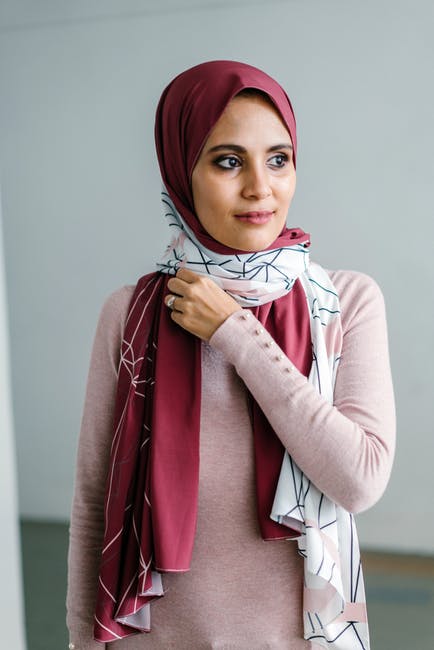
Image: A woman wearing a printed head covering.
Modest fashion for women, including long pants, jeans, long-sleeved sweaters and shirts, jackets, shawls, oversized dresses, and long skirts, is the most popular style. While the conservative style is quite apparent, bright colors abound. Colors like fuchsia, green, red, and blue as well as a variety of prints can be found on many garments, such as oversized dresses and long skirts. Young women can often be spotted wearing a brightly-colored hijab accompanied by a pair of jeans, a long-sleeved shirt, an oversized cardigan, and sporty sneakers, ballet flats, or high heels. However, you are more likely to find these fashionable garments in large cities, such as Cairo, as opposed to smaller areas. In smaller towns, most women wear customary long, loose-fitting dresses and hijabs or niqabs in darker colors.
Future: The fashion industry in Egypt has great potential to grow in the future with a focus on up-and-coming designers, fashion technology, and fashion education. Several of the country’s young designers are gaining attention in Egypt and abroad, and a few are utilizing technology with different purposes in their designs. Recently, an academy was even created to help young women hone their skills and become the next big Egyptian designer.
In 2018, Egyptian fashion designer Farida Temraz presented her collection at New York Fashion Week. She debuted her first collection in 2014 in Paris, gaining the attention of many American celebrities who went on to wear her designs. She won the award for best female couture designer at 2017 New York Fashion Week and continues to design luxurious apparel. Her modern, slightly avant-garde designs often incorporate intricate beadwork, fringe details, pleating, and column-like silhouettes, paying homage to certain ancient Egyptian elements.
In contrast, some Egyptian designers are choosing to look to the future for inspiration instead of the past. Sara Hegazy is an up-and-coming designer who has showcased her work in Europe and earned numerous awards for her designs. She often integrates fiber optics, laser cutting, and 3D printing into her more high-end designs, experimenting with what is referred to as “haute-tech fashion.” Despite her attempts to bring attention to the technology, Sara admits that Egypt still favors conventional materials and hand embroidery. Therefore, Egypt still requires time to adapt to the changing technology in fashion.
To encourage and train future designers for the ever-changing fashion industry, the Young Fashion Academy (YFA) launched in June 2012 to fill a void in fashion education. Founded by Tamr Adly Rizkallah, a fashion designer, the academy teaches girls ages nine to seventeen about the fashion industry. Specific skills, such as sketching, illustrating, rendering, patternmaking, and sewing, are highlighted in the courses. In addition, students research inspiration sources, recognize trends, and learn about fabrics in courses that can last from one month to two years. It is the academy’s goal to provide its students with the support and education they need to eventually pursue a creative occupation.
The Last Stop: Egypt has a fascinating fashion history from the gorgeous, intricate styles in ancient Egypt to the colorful, modest styles of today. Styles from ancient Egypt inspire individuals from all over the world, and many designers frequently turn to them for inspiration. The present fashions in Egypt are beautiful in their simplicity and have great potential for the future as the world develops a burgeoning interest in stylish modest garments. In addition, some of the country’s designers are gaining international acclaim, bringing attention to the Egyptian fashion industry. While certain designers are experimenting with the incorporation of technology into their garments, hand embellishment methods and traditional materials still reign supreme. Nevertheless, Egypt’s fashion industry continues to evolve as it supports promising young talent and gains recognition on the world’s fashion stage.
Thank you to all of my readers! If you found this information helpful and inspiring, or you would like to see a specific topic featured in one of my weekly blog posts, leave a comment! Be sure to check out last week’s post on the past, present, and future of fashion in France, and stay tuned for next week’s country: Nigeria!
My Resources, Your Resources:
Bizawe, Eyal Sagui. “Hijab Fashion in Egypt: A Lot More Than Meets the Eye.” Haaretz, 10 Apr. 2014, https://www.haaretz.com/.premium-a-look-at-hijab- fashion-in-egypt-1.5244647. Accessed 23 Sept. 2018.
Helmy, Heba. “The Future of Fashion: New Academy Develops Promising Talent.” Egypt Independent, 26 Dec. 2012, https://www.egyptindependent.com/future-fashion-new-academy-develops-promising-talent/. Accessed 23 Sept. 2018.
Katrandjian, Olivia. “A Woman’s Guide to Visiting Egypt.” Huffington Post, 28 Dec. 2011, https://www.huffingtonpost.com/olivia-katrandjian/a-womans-guide-to-visitin_b_1063486.html. Accessed 23 Sept. 2018.
Mandal, Dattatreya. “Stunning Bead-Net Dresses: The Zenith of Ancient Egyptian Fashion.” Realm of History, 7 Mar. 2017, https://www.realmofhistory.com/2017/03/07/bead-net-dresses-ancient-egypt/. Accessed 23 Sept. 2018.
Mendes, Valerie, and Amy de la Haye. Fashion Since 1900. 2nd ed., Singapore, Thames and Hudson, 2010.
“Temraza Takes New York Fashion Week.” Cairo Scene, 6 Aug. 2018, http://www.cairoscene.com/Fashion/Exclusive-Temraza-Takes-New-York-Fashion-Week. Accesed 23 Sept. 2018.
Tortora, Phyllis G., and Keith Eubank. Survey of Historic Costume.5th ed., USA, Fairchild Books, 2010.
Yasser, Nayera. “Haute-Tech Fashion: Is Egypt Ready to Wear Technology on its Sleeves?” Daily News Egypt, 4 Aug. 2016, https://dailynewsegypt.com/2016/08/04/haute-tech-fashion-egypt-ready-wear-technology-sleeves/. Accessed 23 Sept. 2018.

 The Global Fashion Files
Find the latest gossip, surprising facts, and more in this infotainment article! https://sites.google.com/view/168news/infotainment
LikeLike