Hello, and welcome to my new blog, The Global Fashion Files! My name is Kylah, and I am a twenty-something-year-old Pennsylvania native with an interest in fashion and the world around me. Through the years, my extracurricular activities have ranged from being a design intern at a gymnastics apparel company to student editor of a fashion newsletter to assisting students from all over the world as a writing center tutor. I am currently a graduate student pursuing a degree in global fashion.
I was inspired to start this blog because I have always wanted to explore fashion in different countries and expand my understanding of the global fashion industry. In order to satisfy my curiosity regarding this topic, I will feature one country each week and discuss topics, such as styles, designers, and technology, related to its past, present, and future in women’s fashion. To begin, we will explore the country considered to be the birthplace of fashion: France!
Past: Much of the allure of French fashion can be traced to the Baroque and Rococo styles in the seventeenth and eighteenth centuries. Baroque—characterized by extravagant embellishment, heavy fabrics, and dark, formal elements—emerged as the prevailing style during Louis XIV’s reign (1661-1715). For formal events, women often wore a three-piece gown, including an over-gown, complementary petticoat, and train, called a mantua. A stiff stomacher, an ornamented triangular panel that fits into the gap of the front of the gown, was worn in conjunction with a mantua and a corset. Informal attire was slightly less restrictive with the sack-back gown, better known as the Watteau gown, featuring pleats on the shoulder and a loose fabric panel cascading down the back of the gown.
The styles of the Rococo period, primarily coinciding with the reign of Louis XV (1715-1774), were more sophisticated, whimsical, and light than the styles of the Baroque period. The classic Rococo gown was the robe à la française that featured a pleated cut at the back and a fitted front. Many of these gowns also had open bodices and skirts to exhibit ornamental stomachers and petticoats. Wide hoops of different shapes, or panniers as they were known in France, helped form the silhouette of the dress. These gowns often showcased nature motifs, understated colors, and intricate decorations, such as ribbons, feathers, and artificial flowers.
From 1795 to 1820, the Empire style was a drastic departure from the more rigid Rococo and Baroque styles. Similar to gowns shown on ancient Greek statues, this style often utilized white gauzy fabrics, including cotton and muslin from India, to create dresses with a higher waistline under the bosom and a low, square neckline. Many women abandoned their corsets and began using shawls and short jackets for modesty and warmth.
In the nineteenth century, Charles Frederick Worth, purported founder of French couture, established Paris as the fashion center of the world. He designed gowns for many famous women, including Empress Eugenie and Queen Victoria, and helped found the Chambre Syndicale de la Couture Parisienne, an organization of couturiers that is still active. He is credited with coining the term “haute couture,” or “high dressmaking.” In order for something to be classified as “haute couture,” it must be constructed by hand from beginning to end and created by fashion houses that are registered with and regulated by French law.
During the twentieth century, France gained the world’s attention again with several emerging designers and fashion styles. Beginning in the 1920s, Gabrielle “Coco” Chanel became popular for designing simple wool jersey dresses and tailored jackets. She is credited with creating “the little black dress” and her signature tweed suits.
In 1947, following the end of World War II, Christian Dior shocked the world with the release of his “New Look.” With a full skirt, a narrow waistline, and slightly sloped shoulders, it was a luxuriously feminine style that accentuated the female form. Each of Dior’s creations required twenty-five yards of fabric, making this style an extravagant departure from wartime rationing.
During the late twentieth century, new couture and ready-to-wear designers brought fresh ideas to the Paris fashion scene. Yves Saint Laurent, Sonia Rykiel, and Karl Lagerfeld are just a few designers who showcased unique design perspectives and offered customers a variety of style options. French ready-to-wear brands also began to thrive as styles became more varied and a greater number of fashion influences, including music, movies, television, and the internet, emerged.
Present: French women have often been regarded as the most fashionable in the world. Through the years, French style has earned a reputation of being minimalistic, elegant, and classic. This statement is still applicable to many of the styles that grace the streets of Paris today.
It is said that French women develop a signature style, often rejecting certain trends in favor of tried-and-true wardrobe pieces. Menswear-inspired garments, striped shirts, neutral colors, trench coats, and scarves dominate the wardrobes of women. Saint James, H&M, Gap, and Zara are popular brands in France along with higher-end brands like Yves Saint Laurent, Chanel, and Hermes.
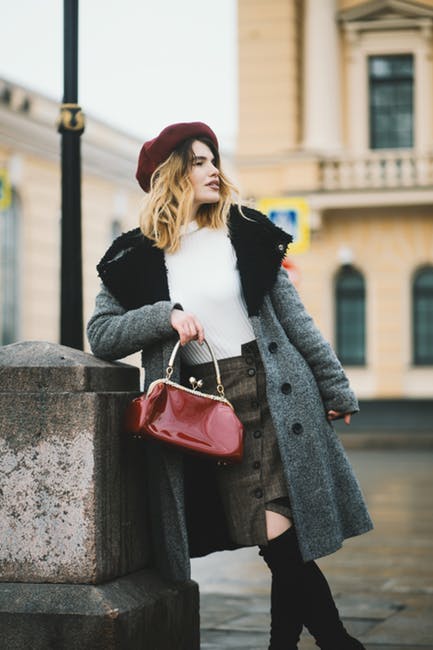
Image: A style typically seen on the streets of Paris.
For the average consumer, less expensive ready-to-wear and fast fashion brands are the practical choice for purchasing clothing—other than the occasional investment piece bought from a premium or luxury brand. While international brands, such as H&M, are common purchases, French fashion brands, such as Maje, Antoine et Lili, and IKKS, are admired as well. Each of these firms has their own brand identity with Maje portrayed as ladylike and carefree and IKKs featuring more classic styles with playful touches to cater to a younger demographic.
Despite the popularity of lower-end, premium, and luxury brands, haute couture still exists in France. More than thirty fashion houses showcase their couture designs twice a year in Paris, but there are only fourteen permanent members of the Chambre Syndicale de la Couture Parisienne. With fewer than two thousand clients globally, haute couture is no longer a profitable business. Many fashion houses continue their couture operations to preserve the artistic aspects of the trade and use it as a marketing tool for more profitable endeavors, such as their more reasonably priced apparel lines, fragrances, and handbags.
Future: Because France is often referred to as “the birthplace of fashion,” it is reasonable to consider its future. France’s fashion industry is steeped in tradition, but it is also one of the most advanced European countries in fashion technology. From a strong e-commerce market to fashion technology-oriented trade shows, France has a promising future in fashion.
Just as in most of the world, e-commerce in France is an important part of the country’s fashion industry. France is the sixth-largest e-commerce market in the world with apparel products among the top-selling items. The amount of money French internet users spend on apparel may increase as the world’s e-commerce fashion segment is expected to grow to $475 billion by 2022.
In addition to its strong showing in e-commerce, France has several established fashion technology trade shows and publications. The FashionTech Expo is held annually, and ModeLab is a publication dedicated entirely to fashion technology. The country also plays host to Première Vision, a prominent apparel textiles and accessories trade show. In 2017, it unveiled the Wearable Lab to evaluate and encourage the pairing of traditional fashion and digital technology. Thus far, exhibitors have ranged from Lectra, a company known for their fashion lifecycle software, to the VISAGE project, a company that produces software for the virtual design of three-dimensional fabric and yarn samples.
While the future of fashion in France appears to be international and local ready-to-wear brands, haute couture is not dead. A study conducted by Bain & Company states that the spending power of Generation Z and Millennials will account for forty-five percent of the global luxury goods market by 2025. Many of the new haute couture customers—women in their twenties and thirties from diverse backgrounds—are encouraging the couture sector to modernize its designs while maintaining the integrity of the art form. Although couture only has a small pool of steady customers, these individuals are dedicated to preserving this French tradition.
In addition to technology, new independent designers are moving the French fashion industry into the future. The Haut Marais district in Paris is full of independent fashion designers creating unique garments in small ateliers, or studios. It is fast becoming a fashion-forward destination with each designer offering a distinct point-of-view. Due to their growing popularity, it is quite possible small districts featuring storefronts operated by independent designers may become the future of fashion in France.
The Last Stop: France played an integral role in the formation of the modern fashion industry. From the more cumbersome and ostentatious styles of the Baroque and Rococo periods to the haute couture designs of Dior to the elegant and minimalist styles of today, French fashion has greatly evolved through the years. Haute couture—potentially one of France’s greatest fashion achievements—continues to face rumors of its demise despite its initial popularity. Nevertheless, fashion houses manage to maintain a clientele of diverse young women dedicated to sustaining haute couture. Moving forward, France is cementing its place as a fashion leader by investing in technology, e-commerce, and emerging design talent. It will be interesting to see if France combines the best elements of its past and present for the advancement of its future in fashion.
Thank you to all of my readers, and I hope you have found this information helpful and inspiring! Stay tuned for next week’s country: Egypt!
My Resources, Your Resources:
Bala, Divya. “How Millennials Have Become Couture’s Biggest Client.” Vogue UK, 11 July 2018, https://www.vogue.co.uk/article/millennials-coutures-biggest-clients. Accessed 11 Sept. 2018.
Bourne, Leah. “12 Timeless Fashion Secrets to Steal from French Fashion Stars.” StyleCaster, Aug., http://stylecaster.com/french-women/. Accessed 11 Sept. 2018.
Dietz, Kasia. “Why Haut Marais is Paris’s Coolest Designer District.” Independent UK, 11 June 2018, https://www.independent.co.uk/travel/europe/paris-haut-marais-neighbourhood-designers-boutique-shopping-why-cool-a8393236.html. Accessed 11 Sept. 2018.
Hare, Mairi. “Tech Couture: Future French Fashion.” Sourcebook EU, 23 Feb. 2018, https://sourcebook.eu/en/blog/tech-couture-future-french-fashion. Accessed 11 Sept. 2018.
Indvik, Lauren. “Couture in Numbers.” Vogue UK, https://www.vogue.co.uk/partnerships/couture-in-numbers. Accessed 11 Sept. 2018.
Ledsom, Alex. “11 Local Brands All French People Love.” The Culture Trip, 17 Jan. 2018, https://theculturetrip.com/europe/france/articles/11-local-brands-all-french-people-love/. Accessed 11 Sept. 2018.
Mackenzie, Mairi. …Isms: Understanding Fashion. Singapore, Universe Publishing, 2010.
Mendes, Valerie, and Amy de la Haye. Fashion Since 1900. 2nd ed., Singapore, Thames and Hudson, 2010.
Orendorff, Aaron. “The State of the Ecommerce Fashion Industry: Statistics, Trends & Strategy.” Shopify, 16 Mar. 2018, https://www.shopify.com/enterprise/ecommerce-fashion-industry. Accessed 11 Sept. 2018.
Peoples, Landon. “Me, Paris, & The $100K Dress.” Refinery 29, 16 July 2018, https://www.refinery29.com/2018/07/203471/haute-couture-paris-fashion-schiaparelli-design-history. Accessed 11 Sept. 2018.
Rodulfo, Kristina. “How 14 French Women Define French Style.” Elle, 28 Oct. 2015, https://www.elle.com/fashion/personal-style/tips/g27203/how-french-women-define-french-style/?slide=1. Accessed 11 Sept. 2018.
Tortora, Phyllis G., and Keith Eubank. Survey of Historic Costume.5th ed., USA, Fairchild Books, 2010.

 The Global Fashion Files